Looking into future from Yole report that reveals the FMCW LiDAR market potential
2024-07-11 18:36
Yole Intelligence, a renowned international consulting firm specializing in semiconductor industry technologies and market developments, recently released its LiDAR for Automotive 2024 Report. This updated report includes a dedicated section on FMCW LiDAR, providing an in-depth analysis of its technological innovations and market potential.
LightIC, as one of the key players in the next-generation FMCW LiDAR space, has been highlighted in the report, contributing to the momentum of industry transformation and market growth.
The report reinforces FMCW technology’s role in advancing both performance and functionality.
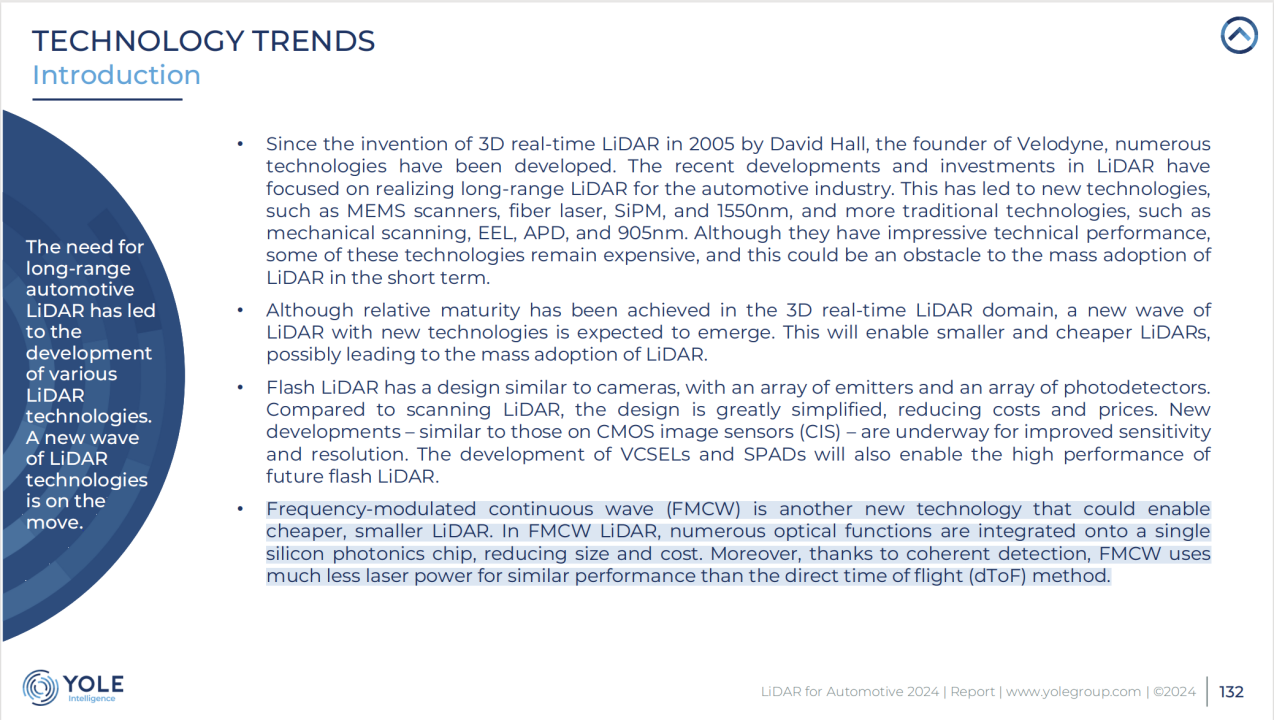
According to Yole, FMCW technology, as an emerging force in the LiDAR field, not only leads the trends of cost reduction and size minimization but also leverages its unique coherent detection mechanism to deliver performance comparable to, or even exceeding Time-of-Flight (ToF) systems. Additionally, FMCW LiDAR significantly reduces the required laser power consumption.
In the evolution of LiDAR products, both ToF and FMCW technologies are pursuing chip miniaturization. The FMCW technology’s more complex detection principle makes miniaturization and integration essential for the mass production of FMCW LiDAR.
Currently, ToF systems typically use VCSEL/EEL and SPAD/SiPM/APD technologies to integrate laser emission and detection modules across multiple discrete chips, which are aligned during assembly.
In contrast, FMCW LiDAR integrates various optical functions—such as laser emission, modulation, beam splitting, optical switching, circulators, mixers, and detectors—onto a single silicon photonic chip. This integration enables multiple-channel emission and reception with natural alignment, resulting in smaller volumes, lower manufacturing costs, and significant advantages in product development.
LightIC has successfully integrated multi-channel transmission (Tx), reception (Rx), and fast, low-loss optical switching matrices into a single silicon photonic module. This innovation significantly increases the integration of FMCW LiDAR systems.
While most ToF LiDAR systems on the market use the 905 nm light source, which struggles to overcome the performance limitations imposed by sunlight interference, LightIC’s FMCW LiDAR employs cutting-edge silicon photonic integration technology to incorporate the 1550 nm light source on a silicon substrate.
The 1550 nm wavelength is in the lower irradiance of the solar spectrum, which minimizes interference even under strong sunlight, significantly improving the signal-to-noise ratio (SNR) and precision of the LiDAR system. This ensures outstanding detection performance and stability across various lighting conditions.
Furthermore, the silicon’s transparent property at 1550 nm facilitates optical alignment and path design, improving optical system stability while reducing optical absorption losses.

Beside, the unique technical principle of FMCW also brings its anti-interference capability.
FMCW systems amplify the signal using the local oscillator (LO). When the optical signal enters the chip, it is split into LO light for storage and detection light for output. The detection light is reflected by the target and identified by its coherence with the LO light, allowing the system to detect only those signals with the same frequency. This characteristic enables FMCW LiDAR to avoid interference from other LiDAR systems, offering a significant competitive advantage in a future where LiDAR systems are widely deployed.
Most importantly, the core competitive edge of FMCW LiDAR lies in its ability to capture and output high-precision velocity data in real-time, a feature far beyond the capabilities of traditional ToF systems. FMCW technology demonstrates exceptional robustness and performance advantages, including long-range detection capabilities, lower transmitter power requirements, and high immunity to environmental light interference, all of which contribute to FMCW LiDAR’s unique competitive position in the future market.

Realize hands-off, Meet eyes-off
The report notes that, in the Automotive market, most new electric vehicles are equipped with one or more LiDAR systems, five radars, and at least eleven cameras, creating sensor suites that enable hands-off Autonomous Driving (NOA) as a standard feature. These sensor configurations deliver an exceptional driving experience on urban roads and highways. Therefore, to achieve higher-level autonomous driving (Eyes-off), the need for next-generation sensors and computing hardware is even more critical.

LightIC FMCW LiDAR for Automotive—LARK—demonstrates superior direct velocity measurement and interference resistance, enabling the system to assess the dynamic state of objects directly.
LARK can identify targets with just 2-3 points and detect target information with a single frame of data. Its quick and stable response supports key applications like ‘Suddenly Opening the Door,’ ‘JayWalking,’ and ‘AEB,’ positioning it as a critical hardware solution for achieving true safety redundancy in advanced autonomous driving systems.
Accelerating FMCW LiDAR Market Growth
As a leading player focused on FMCW technology, LightIC has always believed in and developed the immense potential of FMCW for solving corner cases. Currently, LightICs’ FMCW LiDAR for Automotive—LARK—is in the B-sample and is conducting Proof-of-Concept (PoC) and joint testing with multiple OEMs, with mass production expected in 2026. The company is actively accelerating market development.
LightIC has developed a comprehensive product roadmap from FMCW silicon photonic modules to FMCW LiDAR systems, covering a wide range of applications from autonomous driving to robotics, smart warehousing, and logistics, and integrated smart road systems. The company has also made significant strides in developing solid-state FMCW LiDAR technologies. This comprehensive approach provides customers with a pathway to differentiate themselves from market homogenization and offers consumers a safer and more comfortable experience.

Collaborative Growth Drives Mass Production
Yole’s increased discussion of FMCW technology reflects the market’s immense interest and urgent demand. However, as the report highlights, mass production of FMCW LiDAR faces multiple challenges, including difficulties in silicon photonic chip processing, packaging, testing, unstable upstream and downstream supply chains, and cost management.

Despite these challenges, LightIC is well-positioned to address them. LightIC’s core R&D team possesses extensive experience in silicon photonic chip development and mass production. It holds multiple patents in silicon photonic integration and packaging and has full-stack capabilities from chip design to wafer-level testing and packaging.
Furthermore, LightIC has established a stable supply chain system around semiconductor silicon photonic chips and FMCW technology. Through strategic investments, collaborations, and joint development efforts with upstream and downstream customers, the company is building a strong and stable product ecosystem.
In this process, LightIC will continue to push FMCW technology toward mass production, accelerating its widespread application in autonomous driving, smart transportation, industrial inspection, and other fields, contributing significantly to technological advancement and industry upgrades.
Yole, as a strategic market analyst in the semiconductor and related industries, provides an in-depth market survey and data analysis in this report, offering the latest dynamics, development trends, and potential growth areas for the FMCW LiDAR market. This will foster closer cooperation and resource integration across the industry value chain, enhancing overall competitiveness and innovation capabilities.
Looking ahead, LightIC will continue to embrace an open and cooperative approach, working with global partners to explore new technologies, applications, and challenges. With continued technological innovation, close industry collaboration, and efficient production management, LightIC aims to achieve widespread adoption of FMCW technology in intelligent driving and other advanced fields, creating a new future for intelligent technology.


Hello, what can I do for you?
*Note:We will contact you as soon as possible